 How-to
How to Find Reliable Towing When You Need It Most
Last Updated: November 15, 2026
Quick Summary
To find reliable towing, check recommendations and online reviews for repeated complaints, confirm the company's licensing and insurance, and ask for an itemized quote before any hookup. Save a trusted company's number now, before you're stranded.
- Ask friends, family, and coworkers for firsthand towing experiences in your area.
- Confirm the company's state towing license number and insurance coverage in writing.
- Get an itemized quote covering base fee, mileage, after-hours charges, and storage.
- Confirm the driver's name and truck number match the vehicle that arrives.
- Take photos of your vehicle from all four sides before the tow begins.
Table of Contents
- Why Choosing the Right Towing Company Matters
- Start With a Roadside Safety Checklist
- How to Find Reliable Towing Reviews and Recommendations
- Verify Licensing, Insurance, and Credentials
- Questions to Ask a Towing Company Before You Book
- How to Read a Towing Company Quote and Spot Hidden Fees
- How to Avoid Towing Scams After a Breakdown
- Booking Your Tow With JETZ TOWING
- Frequently Asked Questions
Why Choosing the Right Towing Company Matters
When your car dies on the side of the road, the company you call shapes the next few hours.
Learning how to find reliable towing before you need it puts you in control.
Here is what the right choice protects:
- Your safety. A driver who knows how to work near traffic keeps you off the roadway.
- Your vehicle. The wrong equipment can crack a bumper, damage a transmission, or scratch paint.
- Your budget. A clear quote helps you avoid surprise charges after the job is done.
The best time to vet a towing company is now, while your car is running and your head is clear. Save a trusted number in your phone and check it against the steps below.
Start With a Roadside Safety Checklist
Before you call anyone, take a few seconds to protect yourself.
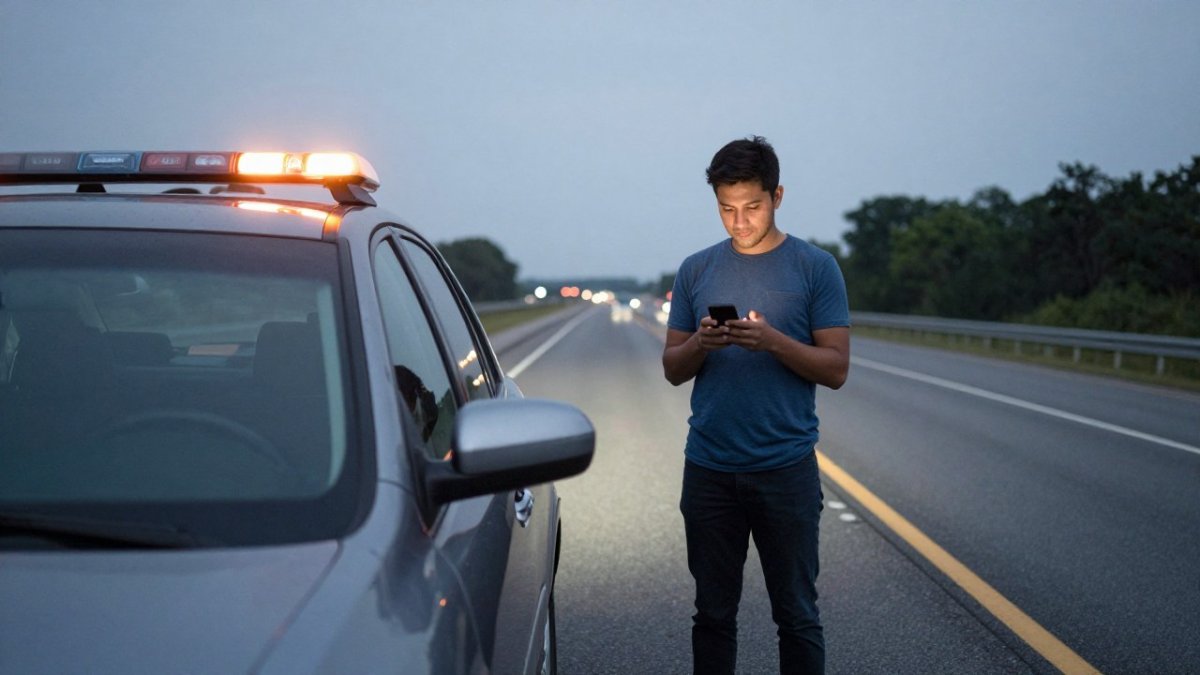
- Get off the roadway if you can do so safely. Use the shoulder or the nearest exit.
- Turn on your hazard lights so other drivers can see you.
- Stay inside the vehicle if you are on a busy highway with no safe place to stand.
- Set out warning triangles or flares only if you can do it without stepping into traffic.
- Note your exact location. Look for mile markers, exit numbers, cross streets, or a nearby landmark.
- Take a photo of your surroundings and any visible damage to your vehicle.
- Keep your phone charged. Turn off nonessential apps and use a car charger if you have one.
Once you are safe, you are ready to call. Having your location and vehicle details ready speeds up dispatch and helps the company send the right truck.
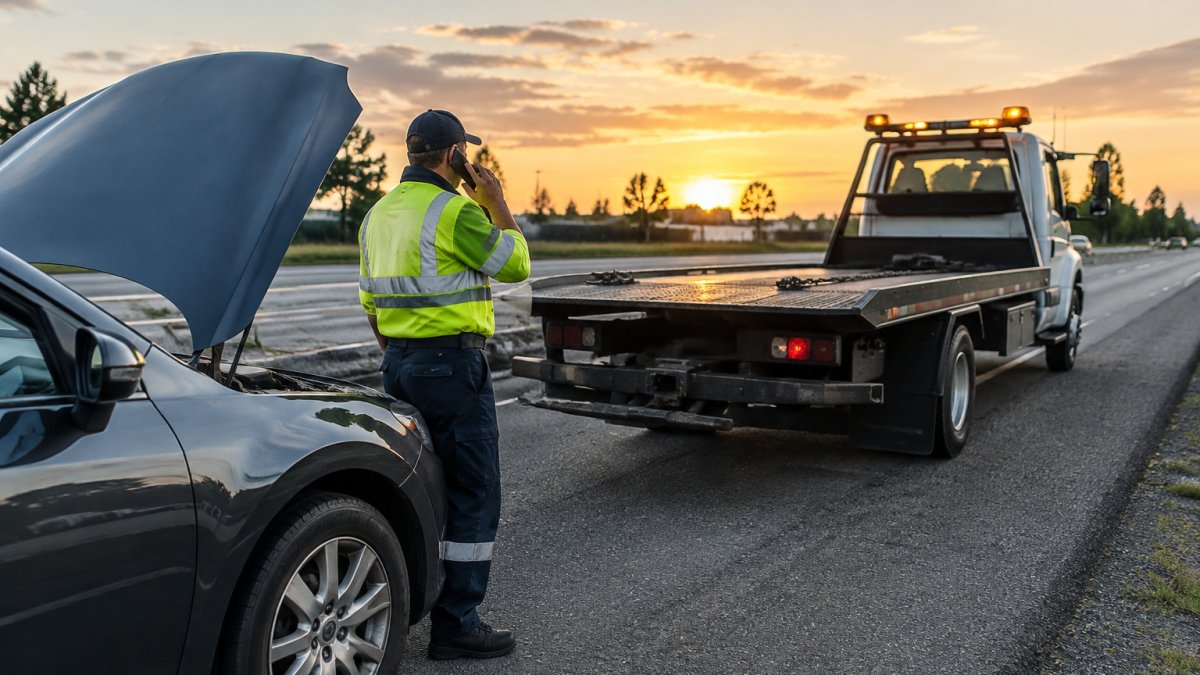
!Driver standing behind a parked car on a highway shoulder at dusk, hazard lights flashing, phone in hand
How to Find Reliable Towing Reviews and Recommendations
Start with people you trust.
Next, check online reviews. Look at the overall rating, but read the actual comments too. Pay attention to these patterns:
- Repeated mentions of long wait times
- Complaints about surprise charges after the tow
- Praise for courteous drivers and careful handling
- How the company responds to negative feedback
A few bad reviews are normal. What matters is whether the complaints describe the same problem over and over.
Also consider roadside assistance programs included with your auto insurance or vehicle warranty, which often maintain lists of approved towing companies in your area.
Watch out: Ratings can be inflated by fake reviews. Be cautious of any company with dozens of five-star reviews posted within a few days and no detailed comments.
Verify Licensing, Insurance, and Credentials
A legitimate towing company should be able to show proof of its licensing and insurance. Requirements vary by state, so check with your state's department of motor vehicles or the agency that regulates towing in your area. Ask any company directly:
- What is your state towing license number?
- Are your trucks registered and inspected?
- Do you carry liability insurance and cargo insurance?
- What happens to my vehicle if it is damaged during transport?
A reputable company answers these questions directly. Vagueness or refusal to give details is a warning sign.
Insurance matters most if something goes wrong. Ask whether the company's insurance covers damage during the tow, and get the answer in writing. Your own auto policy may also provide towing coverage, so review it before you need it. Our towing insurance coverage guide explains what policies typically cover.
Red Flags to Avoid
Certain behaviors should make you walk away from a towing company immediately:
- No business name or phone number on the truck or in its advertising
- Unmarked trucks that arrive without any company identification
- Refusal to give a written quote before hooking up your vehicle
- Pressure to sign blank forms or agree to charges you have not seen
- Demanding cash only with no receipt or invoice
Trust your instincts. If the driver seems unprofessional or the situation feels unsafe, ask for a supervisor or call the police.
Questions to Ask a Towing Company Before You Book
A list of questions is only useful if you know what a good answer sounds like.
**1.
2. Do you serve my exact location? Give the cross streets, mile marker, or exit number, not just the city.
**3.
**4.
5. Where exactly will you take my vehicle? Get the street address of the storage or repair facility, not just the name.
**6.
**7.
**8.
**9.
**10.
How to Use the Answers to Compare Providers
Write the answers next to each company's name so you can compare them on the same basis. A provider with a slightly higher quote that confirms the right equipment, provides a written estimate, and explains the storage location is often the better choice than the cheapest caller.
Use these questions to compare providers, and note the answers side by side to judge which company is most reliable.
| Question | What a good answer looks like | Why it matters |
|---|---|---|
| What is your estimated arrival time? | A range, such as 30 to 45 minutes | Shows realistic dispatch |
| Do you serve my exact location? | Confirms cross streets or mile marker | Some providers limit pickup areas |
| What is the total price, itemized? | Base fee, mileage, after-hours charge listed separately | Prevents surprise charges |
| What equipment will you send? | Flatbed for all-wheel-drive, electric, or damaged vehicles | Wrong equipment can cause damage |
| Where will you take my vehicle? | Full street address of the facility | Confirms the agreed location |
| Are you licensed and insured? | License number and insurance carrier provided | Protects you if damage occurs |
| Can you confirm the driver and truck? | Driver name and truck number match arrival | Unmarked trucks are a red flag |
| Do you offer 24/7 emergency service? | Answered around the clock | Breakdowns happen after hours |
How to Read a Towing Company Quote and Spot Hidden Fees
A reliable quote is itemized, time-stamped, and tied to a specific pickup and drop-off address.
Use this checklist to confirm each charge in advance. Ask about every line, even the ones that seem obvious.
- Base hookup or dispatch fee. The flat charge to send a truck and attach your vehicle. Confirm whether it applies even if you cancel before the truck arrives.
- Mileage rate and mileage basis. Ask whether mileage is billed from the dispatch location, the pickup location, or the tow yard, and whether it is calculated one way or round trip. The difference can be substantial on a long tow.
- After-hours, weekend, and holiday surcharges. Confirm the exact window when these apply, since a call at 6:55 p.m. can land on either side of a rate change.
- Winching, recovery, or off-road fee. Ask what triggers this charge, such as a vehicle in a ditch, snow, mud, or a parking structure with low clearance.
- Special-equipment fee. Flatbed, dolly, or wheel-lift equipment may carry a separate charge, especially for all-wheel-drive, electric, luxury, or damaged vehicles.
Once you have two or three itemized quotes, compare them on the same basis. A quote that looks higher on the base fee may be lower once mileage and after-hours charges are included, and a quote that looks lower may exclude winching or storage. Write the totals down next to each other rather than comparing from memory.
Watch out: A quote given only by phone, with no company name, truck number, or written confirmation, is difficult to enforce if the driver demands more on arrival.
What to Do If the Price or Arrival Time Changes
A revised estimate is not automatically a scam, but it should come with an explanation and your consent before the vehicle moves. A driver quoting more after seeing a condition the dispatcher could not, a flat tire on a low-clearance car, a vehicle in a tight garage, can be legitimate.
Use this decision process when the number moves:
- Ask what changed. Get a specific reason tied to the vehicle or location, not a vague reference to "difficulty."
- Ask for the revised total in writing by text or email before you authorize the hookup.
- Compare it to your other quotes. If the revised number is far outside the range you collected, you are allowed to decline and call another provider.
- Do not sign a blank form or an authorization with empty fields. Read what you sign and keep a copy.
- If the vehicle has already been moved and the price changed without consent, ask for the itemized invoice, pay by card if possible to create a record, and contact your state consumer protection office or the agency that regulates towing in your area.
If the arrival time slips, ask for a new window and a reason. A provider that communicates a delay is easier to work with than one that goes silent.
How to Avoid Towing Scams After a Breakdown
Scams often target drivers in vulnerable moments. Stay alert to these common tactics:
- Bait-and-switch pricing. A company quotes a low price by phone, then demands much more on arrival.
- Holding your car hostage. Some companies refuse to release your vehicle until you pay an inflated fee. If this happens, call the police and your state consumer protection office.
- Unsolicited tow trucks. Drivers who appear at the roadside uninvited may charge far more than a company you called yourself.
- Towing to an unexpected yard. If the driver takes your car somewhere other than the agreed location, ask why and refuse to sign until it is explained.
Protect yourself with a simple rule: only accept a tow from a company you called, and confirm the price before the hookup begins. Take photos of your car before the tow starts, and keep your receipt.
Booking Your Tow With JETZ TOWING
At JETZ TOWING, we offer light and duty towing and roadside assistance across the Greater Sacramento area. Compare our towing and roadside services, including jump starts, tire changes, and classic car towing.
When you need a tow, the process is simple. First, confirm we cover your neighborhood in our Carmichael and nearby communities service area.
Ready to get moving? Request a tow with JETZ TOWING.
Frequently Asked Questions
How can I tell if a towing company is reliable?
Look for a company that shows its legal name and address, a state-issued license and proof of commercial auto and garage liability insurance, and a clear service area. Reliable operators give you their dispatch number, estimated arrival time, and an itemized price before the truck leaves. Consistent online reviews over several months are more useful than a handful of recent five-star ratings. If a company is evasive about any of these details, keep looking.
What should I ask a towing company before hiring them?
Ask whether the company is licensed and insured, what its estimated arrival time is, and whether it can handle your vehicle type, such as a low-clearance car, a motorcycle, or a classic. Confirm the base rate, mileage charges, and any after-hours or hookup fees. Ask what equipment they use for your vehicle and what happens if your car is damaged during transport. Write down the answers and the name of the dispatcher you spoke with.
How do I avoid towing scams after a breakdown?
Be wary of companies that call or approach you at the roadside without you requesting service, or that quote a low price over the phone and raise it on arrival. Never sign a blank form or agree to a tow before the price is confirmed in writing. Verify the company's name, address, and license number independently, and avoid operators who refuse to give a business name. If the driver pressures you to pay before the vehicle is moved, call the police non-emergency line for guidance.
What information should I give a tow truck dispatcher?
Give the exact location, including the nearest cross street, mile marker, or landmark, along with your phone number. Describe the vehicle's year, make, model, and color, and say whether it is running, is in neutral, has a flat tire, or has locked wheels. Note whether it is all-wheel drive, low to the ground, or a classic that needs special handling. Tell the dispatcher your destination so you can ask for a total price before the truck is dispatched.