 How-to
7 Steps to Take When Your Car Breaks Down on the Road
Quick Summary
Get your car off the traffic lane, turn on your hazard lights, and stay buckled in unless exiting is clearly safer. Then call for help and share your exact location, because emergency towing is only as fast as the information you give the dispatcher.
- Signal and steer toward the shoulder, stopping as far right as you can.
- Turn on hazard lights right away so other drivers know something is wrong.
- Stay inside on busy highways, near curves, or in bad weather unless the car is a fire hazard.
- Never stand between your car and moving traffic or push the car near live lanes.
- Confirm your mile marker or exit and share a pin before calling the dispatcher.
Table of Contents
- Why Commuter Breakdowns Are Riskier Than They Look
- Your First Moves: Getting the Vehicle Off the Traffic Lane
- What to Do When Your Car Breaks Down: Staying In or Getting Out
- Roadside Emergency Checklist for Your Trunk and Dashboard
- Move Over Law for Tow Trucks: What Drivers Must Do
- Average Roadside Assistance Response Time and How to Plan Around It
- Booking Your Tow With JETZ TOWING Safely and Quickly
- Frequently Asked Questions
Why Commuter Breakdowns Are Riskier Than They Look
Last Updated: November 4, 2026
A car that dies on a busy road is more dangerous than most drivers expect.
Emergency towing safety for commuters starts with one idea: get off the traffic lane, get visible, and get help. That sounds simple. In practice, panic and fast-moving cars make it harder than it looks.
The biggest risk is not the breakdown itself. It is the moments after, when drivers step out into live traffic or stay in a spot where other cars cannot see them.
- Traffic on busy roads often moves faster than the posted speed limit
- Shoulders may be narrow, uneven, or missing entirely
- Drivers may not see a stopped car until they are very close
- Stress and time pressure lead to rushed, risky decisions
Your First Moves: Getting the Vehicle Off the Traffic Lane
The first goal is to move the car out of the traffic lane. Signal, steer toward the shoulder, and stop as far to the right as you can.
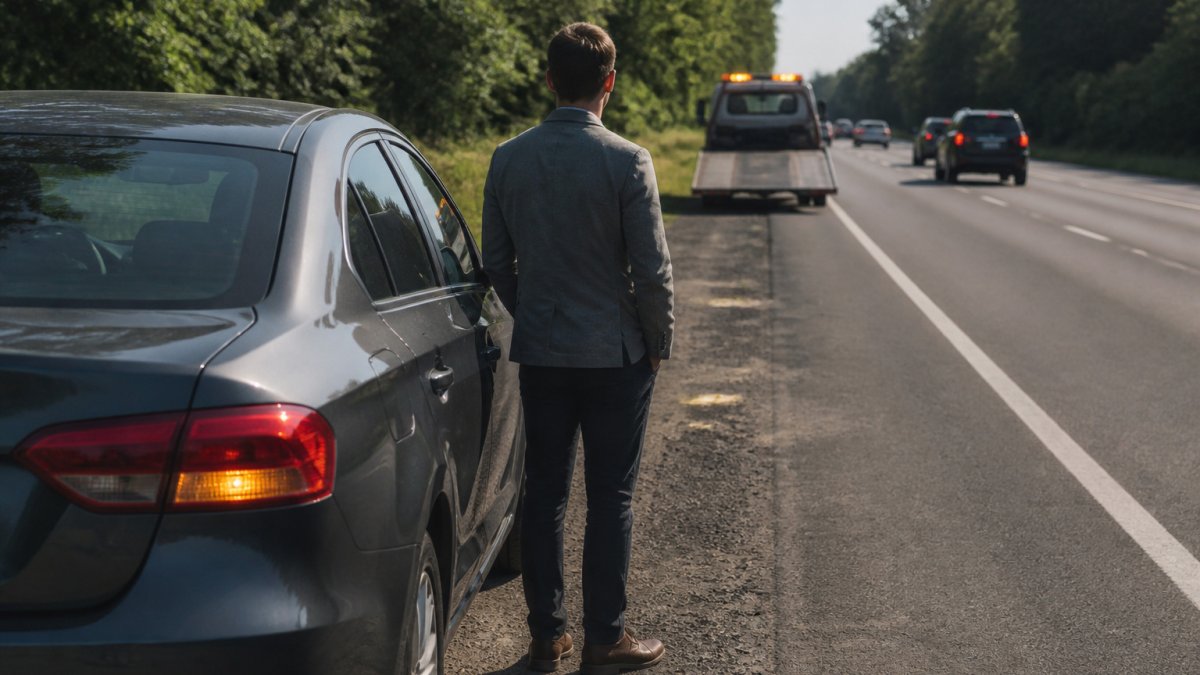
Turn on your hazard lights right away. They tell other drivers that something is wrong.
!A driver standing safely on a roadside shoulder beside a parked sedan with hazard lights blinking, a tow truck visible in the distance on a sunny afternoon
Watch out: Do not try to push the car by hand while standing near moving traffic, as this can lead to injury.
What to Do When Your Car Breaks Down: Staying In or Getting Out
Whether you stay inside or get out depends on where you stopped, how fast traffic is moving, and what protection the roadside offers. The safest choice is usually to stay in the vehicle with your seatbelt on, unless leaving is clearly safer. The hard part is judging "clearly safer" in the first 30 seconds, so work through the factors below in order.
Commuter decision tree: stay inside or exit
- Where is the car? If you are in a live traffic lane, on a narrow shoulder, near a curve, or just over a crest, stay buckled in. If you are fully off the road behind a barrier with a wide clear zone, exiting may be reasonable.
- How fast is traffic moving? Watch two or three cars pass. If they are moving well above the posted limit or passing close to your door, stay inside.
- What is between you and traffic? A guardrail, concrete barrier, ditch, or raised median gives you a protected path. A flat shoulder with no barrier does not.
- What is the weather and light? Rain, snow, fog, and darkness all reduce how soon other drivers see you. In low visibility, stay inside with hazards on and do not walk the shoulder.
- Is the vehicle itself a hazard? Smoke, fire, a strong fuel smell, or a vehicle sitting in a lane that cannot be moved means exit immediately, even if the roadside is imperfect.
- Stay inside on busy highways, near curves or crests, on narrow shoulders, in bad weather, or at night when you cannot see a clear protected path
- Exit only when fire, smoke, fuel smell, or an exposed lane position makes staying put more dangerous
- Exit toward the passenger side, away from traffic, and move behind a guardrail or fence if one exists
- Never stand between your car and moving traffic, and never stand in the shoulder lane to wave drivers around
Watch out: Opening a driver-side door into traffic can turn a breakdown into an injury. If you must exit on the traffic side, check the mirror and look over your shoulder twice before opening the door even a few inches.
Passengers with children, pets, or limited mobility
Passengers need extra planning because they cannot always make the stay-or-exit call themselves. Keep children buckled in their seats unless you must move them, and keep pets leashed or in a carrier so they do not bolt toward traffic when a door opens. If someone has limited mobility, call for help early and tell the dispatcher exactly what is needed, so responders and the tow operator arrive prepared.
- Keep children strapped in and calm; explain what is happening in short, simple terms
- Never leave a child or pet alone in a car next to traffic, and never send a child to place warning devices
- Tell the tow operator if a passenger needs help getting out safely, uses a wheelchair or walker, or cannot walk far
- If a passenger must exit, move them as a group to the protected side and keep them behind a barrier
- For pets, crack a window for airflow but keep the animal contained until help arrives
Roadside Emergency Checklist for Your Trunk and Dashboard
Keep a few basic items in your car so you are ready when a breakdown happens. A small kit can make waiting safer and faster.
- Reflective warning triangles or flares
- Flashlight with spare batteries
- Phone charger and power bank
- Jumper cables
- Spare tire, jack, and lug wrench
- Bottle of water and a few snacks
- Reflective vest or bright jacket
- Written list of emergency contacts
Check your spare tire, tire pressure, and washer fluid every few months. Look over belts and hoses too, since small problems often cause breakdowns.
Move Over Law for Tow Trucks: What Drivers Must Do
Many states have move over laws that require drivers to change lanes or slow down when they pass stopped emergency vehicles, tow trucks, and roadside workers with flashing lights. The rules vary by state, so check your local requirements. In general, if you cannot safely change lanes, slow down and stay alert.
If you are the one waiting for help, stay aware of passing traffic. A visible vehicle with hazard lights on and a clear view for approaching drivers helps everyone stay safer.
Average Roadside Assistance Response Time and How to Plan Around It
Response times depend on location, time of day, weather, and how busy the roads are, so it helps to plan ahead. For more detail, read our guide on what to expect for average response times. Rather than guess at a number, treat the estimate the dispatcher gives you as a planning input and use the call itself to shorten the wait.
Step-by-step: connecting with a tow operator
- Confirm your location before you call. Read the nearest mile marker, exit number, or cross street, and note the direction of travel. Check whether we cover your area in our service communities around Carmichael. If you are on a highway, the direction matters as much as the road name because the dispatcher needs to send a truck to the correct side.
- Share a pin if you can. Most map apps let you drop a pin or share your live location by text. Send it to the dispatcher if they support it, and keep your phone charged.
- Describe the vehicle and the problem. Give the make, model, color, and plate, plus whether the car rolls, steers, or has a flat. This tells the dispatcher what kind of truck and equipment to send.
- Flag passenger needs up front. Say if children, pets, or someone with limited mobility are with you, and whether anyone needs medical help. If there is any injury or immediate danger, call 911 first.
- Ask for the estimate and the truck description. Get an arrival window and ask what the truck looks like and who will be driving, so you can verify the vehicle when it arrives.
- Stay on the line if you feel unsafe. If traffic is passing too close or the situation changes, tell the dispatcher and ask whether you should move or wait.
If the wait runs long
Ask for an updated estimate if the arrival window passes. If the wait feels unsafe, call again and describe the specific hazard, such as cars passing within a few feet or a passenger who cannot stay in the vehicle. Do not walk along the shoulder to look for the truck, and do not accept a ride from an unsolicited vehicle that was not dispatched to you. Verify the company name and the driver before anyone touches your car.
The steps below summarise how to connect with a tow operator and what to do if the wait runs long.
| Step | What to do | Detail |
|---|---|---|
| Confirm location | Read the mile marker, exit number or cross street | Note direction of travel |
| Share a pin | Send live location to the dispatcher | Keep your phone charged |
| Describe vehicle | Give make, model, color and plate | Say whether it rolls, steers or has a flat |
| Flag passenger needs | Tell dispatcher about children, pets or limited mobility | Call 911 first if injured |
| Get estimate | Ask for arrival window and truck description | Verify the vehicle on arrival |
| Stay on the line | Report any unsafe change to the dispatcher | Ask whether to move or wait |
Booking Your Tow With JETZ TOWING Safely and Quickly
When you are ready to book a tow, call JETZ TOWING at 916-628-8646. Have your location, vehicle make and model, and a description of the problem ready so we can dispatch the right help quickly. You can compare our towing and roadside services before you call.
Our licensed and insured team handles light-duty towing and roadside assistance. Our team will get you back on the road safely and with peace of mind.
To request a tow today, contact JETZ TOWING online or call 916-628-8646.
Frequently Asked Questions
What is considered emergency towing?
Emergency towing is the removal of a vehicle that cannot be driven safely or legally from its location, usually because of a mechanical breakdown, a collision, a dead battery, a flat tire without a usable spare, or a lockout. Unlike scheduled or flatbed transport, it is requested in response to an immediate problem, and the goal is to get the vehicle and its occupants out of traffic as quickly as possible. Commuters should keep their roadside assistance membership details and the towing company's dispatch number saved in their phone so the request can be made within seconds.
What should commuters do first when their vehicle breaks down?
The first priority is getting the vehicle out of the active travel lane. Steer toward the shoulder or the nearest safe exit, turn on the hazard lights, and set the parking brake. If the car cannot move, stay calm, keep your seatbelt on while assessing traffic, and call for help. Wait until you have a clear view of oncoming traffic before opening a door, and avoid standing between the vehicle and moving cars. Sharing your location through a navigation app or a text message to a family member helps dispatch find you faster.
When should you stay inside your vehicle instead of getting out?
Stay inside when you are on a high-speed road with no protected shoulder, when traffic is passing close to the door, or when you are on an overpass or bridge where exiting would expose you to fast lanes. Keep your seatbelt on and your phone charged. Exit only when the vehicle is in immediate danger, such as smoke, fire, or fuel leaks, and move well away from the road toward a barrier. Passengers with limited mobility or young children may need help from emergency responders, so call 911 if exiting is unsafe.
What is the move over law for tow trucks?
Move over laws in most U.S. states require drivers approaching a stopped emergency or roadside service vehicle with flashing lights to change lanes when it is safe to do so, or slow down significantly if a lane change is not possible. Requirements differ by state, so check your state's vehicle code for the exact rules and fines. Slowing down and giving tow operators working on the shoulder as much space as possible protects both the driver and the people working beside the road.